Rightly Divide or Accurately Handle?

Preamble

God has one great purpose fulfilled through a two-fold plan for the ages.  God’s one great purpose is to be glorified through His Son, the Lord Jesus Christ.  God’s two-fold plan through which He will accomplish that is implied in the first verse of the Bible:

In the beginning God created the heaven and the earth.

Gen 1:1

God will be glorified in heaven and earth.  He is the most high God.  He is the Creator of heaven and earth, and He is the Possessor of heaven and earth. 

There was, however, a rebellion in heaven before the world began.  That is why the body of Christ is God’s eternal purpose planned before the world began (Rom 16:25).  The body of Christ was planned in response to the fall of Lucifer.  Lucifer willingly fell.  He was created perfect and upright and he chose to lift up his heart in pride.  God will correct that situation.

When God created man perfect and upright, man chose also to disobey the word of God.  Adam willingly sinned against God.  Thus, the Bible presents to us a rebellion in heaven before the world began and a rebellion on earth after it was created.  God created Adam in response to Lucifer’s fall and He gave him dominion on the earth.  Adam chose to rebel against God, however.  There has thus been a rebellion in heaven and earth that God has chosen to reconcile via a two-fold plan.  This reconciliation involves the government of heaven and earth:

For by him were all things created, that are in heaven, and that are in earth, visible and invisible, whether they be thrones, or dominions, or principalities, or powers: all things were created by him, and for him:

Col 1:16

Israel is God’s earthly people and they will be His agent to reconcile the government of the earth.  The body of Christ is God’s heavenly people, and we will be His agency to reconcile the government in heavenly places.

With all that being said, please recognize that the well-intentioned Christian cannot understand what I have just detailed for you if they do not rightly divide the word of truth.  Satan (Lucifer) does not want you to have this foundational understanding of your Bible.  Since the chief tool within Satan’s arsenal today is deception through false doctrine, he works very hard to hide this truth from all well-intentioned Christians.  One of Satan’s tactics is the use of Bible perversions and the confusing of verses and words within God’s written revelation.  This article will focus upon one important place within God’s word where Satan has decided to expend extra energy in deceiving the bulk of Christendom:  2 Timothy 2:15.

Handle or Divide?

The key to understanding the Bible is found in one verse in which we are told to study the word of God.  Within the same verse, God told us how to study His word:

Study to shew thyself approved unto God, a workman that needeth not to be ashamed, rightly dividing the word of truth.

2 Tim 2:15 KJV

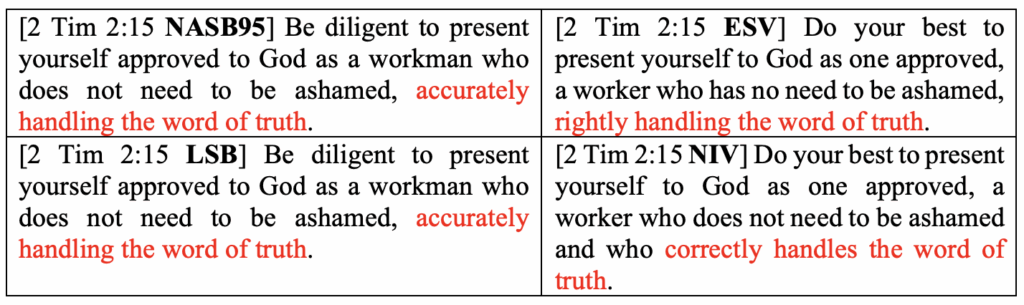
Is this a verse that you have recognized and noted during your past readings of the Bible?  If you are studying from a “modern day” translation of the Bible, then the probability is very high that you have not recognized the command to “rightly divide the word of truth” within Scripture:

The “modern day” translations of the Bible have chosen to use the word “handle” as opposed to the King James’ use of the word “divide”.  This may seem harmless enough, but in fact, it is a massive departure from the intention of the command provided to us by God, through the apostle Paul. 

The Greek

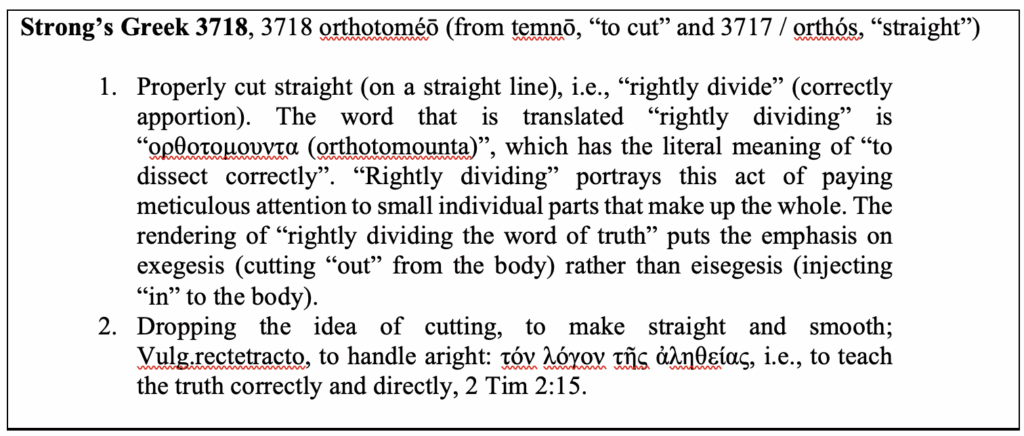
The King James Bible has its own internal dictionary – words within the KJB are interpreted within Scripture.  This, however, is not an issue of internal definition within the KJB, thus it is necessary for us to look at the Greek:

Various Bible Study tools also assist with a proper understanding of the command within 2 Timothy 2:15 –

3718. ὀρθοτομέω ŏrthŏtŏmĕō, or-thot-om-eh´-o; from a comp. of 3717 and the base of 5114, to make a straight cut, i.e. (fig.) to dissect (expound) correctly (the divine message):—rightly divide.  Strong, J. (2009). A Concise Dictionary of the Words in the Greek Testament and The Hebrew Bible (Vol. 1, p. 52).

The Septuagint

The Greek word orthotomeō, translated as “rightly divide,” is found only one time within the King James Bible (2 Timothy 2:15).  Since we are looking at the Greek, we do possess one advantage that is capable of assisting our research.  The LXX, the Septuagint, is the Greek translation of the Hebrew Scriptures, known to you and me as the Old Testament.  Thus, it behooves us to look at the LXX to identify if this Greek word orthotomeō was used within its translation of the Old Testament.  The word orthotomeō is used twice within the LXX:

The righteousness of the perfect shall direct his way: but the wicked shall fall by his own wickedness.

Prov 11:5 KJV


In all thy ways acknowledge him, and he shall direct thy paths.

Prov 3:6 KJV

These two Old Testament verses, both from Proverbs, reinforce the concept “to make straight” described in Strong’s Greek 3718.

Two or More Witnesses

One principle of hermeneutics that this author always desires to employ comes by way of 2 Corinthians 13:1b – “…In the mouth of two or three witnesses shall every word be established.”  This principle of hermeneutics is supported by Deuteronomy 19:15, Matthew 18:16, and John 8:17.

As stated previously, our instruction to “rightly divide the word of truth” is found within only one verse (2 Timothy 2:15) within the King James Bible.  This should concern us, but one would have to discount the ministry message of the apostle Paul and his 13 epistles in order to not notice a “second witness” to this command found in 2 Timothy 2:15.  That said, most students of the Bible are surprised to learn that there is actually a second witness to 2 Timothy 2:15 provided within the predecessor to the King James Bible, that being the Geneva Bible.  What the KJB translates as:

That ye may approve things that are excellent; that ye may be sincere and without offence till the day of Christ;

Phil 1:10 KJV

…is translated within the Geneva Bible as:

That ye may discern those things that differ one from another which are best, that ye may be pure, and without offence, until the day of Christ, 

Phil 1:10 Geneva

Paul prayed in Philippians 1:9 that the Philippians’ love might abound in knowledge and judgment. This increase in knowledge and judgment was “to discern the things that differ”.  The KJV rendering “approve things that are excellent” is a poor rendering.  It is better understood as “testing or discerning the things that differ”.  That position absolutely fits with the intention of 2 Timothy 2:15 and it provides us a second witness within the word of God that when combined with a proper understanding of the apostle Paul’s ministry and message, it provides the student of the Bible a solid emphasis upon the need for separating God’s truth from God’s truth within His word.

Why Does This Matter?

“Rightly dividing” the word of truth is not an issue of dividing truth from error because there are no errors within the Bible.  Rightly dividing is an issue of recognizing and consistently maintaining the divisions that God put in His word.  For example, what was truth for Israel under the Law may not be truth for the body of Christ under grace.  The student of the Bible needs to discern the difference or they will place themselves under the wrong instruction and doctrine.  This is the dispensational approach to Bible study and it is something that Satan loves to confuse.

All Bible students divide the Bible to some extent and in some way, but most do not rightly divide the Bible.  We must be careful not to invent our own divisions or to ignore the ones that God has placed within His word.  A most obvious division within the Bible is between the Old Testament and the New Testament, but that division was not placed within your Bible by God, the Holy Spirit, it was placed there by the editors and the publishers of the Bible that you purchased.  The Old Testament actually began in Exodus (see Exod 24:6-8) and Scripture tells us that the New Testament began with the shed blood of Christ on the Cross (Heb 9:15-17; Matt 26:28).  Technically speaking, the four Gospels of Matthew, Mark, Luke, and John are Old Testament books and rightly dividing the word of truth makes that abundantly understandable. 

The main division within the Bible is not between the Old Testament and the New Testament, but actually between the prophetic kingdom program of God’s earthly people, Israel, and the mystery program of His heavenly people, the body of Christ.  In short, the main division within the Bible is between Prophecy and Mystery (compare Acts 3:21 against Romans 16:25).  The first verse of the Bible introduces the whole Bible by revealing that God has a purpose for heaven and for the earth (Gen 1:1).  God will reconcile both realms and He is doing that through a Prophecy program and a Mystery program.  From Genesis until the ministry of the apostle Paul, God’s revelation concerned the earth.  This is the Prophecy program.  The apostle Paul’s 13 epistles concern God’s heavenly people, the body of Christ.  This is the Mystery program.

Prophecy vs. Mystery stands as one of the primary ways in which the Bible is to be rightly divided, but there are many other ways in which divisions can be made.  The apostle Paul, within his 13 epistles, identifies the following ways in which the student of the Bible can cut straight, rightly divide, or dissect correctly the word of God:

  • Prophecy (Acts 3:21) vs. Mystery (Rom 16:25)
  • Times Past (Eph 2:2, 11), But Now (Eph 2:13; 5:8), Ages to Come (Eph 2:7)
  • Faith to Faith (Rom 1:17; Heb 11)
  • Law vs. Grace (Rom 6:14-15)
  • Faith vs. Works (Eph 2:8-9; Gal 2:16)
  • Dispensations (Col 1:25; Eph 1:10; 3:2; 1 Cor 9:17)
  • Peter’s ministry (Acts 2:37-38) vs. Paul’s ministry (Acts 16:29-32)

Realize that each one of these approaches to dividing the Bible during one’s studies supports each of the other items in the list and they do not stand in conflict with one another.  The student of the Bible must recognize that grace doctrine, for example, is very different from Law doctrine and that it is crucial that one ‘cuts’ the Scriptures straight, in order to divide the content of the Law from the content of Grace.  The two doctrines cannot mix, and right division is imperative to keep Grace doctrine sound and to properly identify the instructions that have been provided to the body of Christ for today, during the dispensation of the grace of God (Eph 3:2).  Unfortunately, many denominations have not recognized this crucial instruction from the apostle Paul to rightly divide the Scriptures, and thus, by mixing the two doctrines of Law and Grace, have caused great confusion within the Church, with the end result being the creation of thousands of denominations that do not teach sound doctrine.

Conclusion

Right division is not optional, it is obedience, and it is obedience to the command given to us in 2 Timothy 2:15.  Satan and his minions (Rev 12:4) work tirelessly to keep the truth of God’s word from penetrating the understanding of those who have accepted the Bible to be the holy word of God.  The very entity that God has chosen to replace Satan and his minions must see the truth of 2 Timothy 2:15 and must apply its instruction to its daily walk.

Despite what the “modern versions” of the Bible say, no one can “correctly handle” the word of truth if they are not rightly dividing the word of truth.  The word of God will certainly work effectually in those who believe it (1 Thes 2:13).  However, while all the Bible is for our learning (Rom 15:4), it was not all written directly to us or about us and it requires to be rightly divided to be understood properly.


Leave a Reply

Your email address will not be published. Required fields are marked *