
I would ask that you please grab your Bible, the one you study from, the one you carry with you on Sunday mornings to church.
Please turn to the Gospel of Mark, chapter 1.
Please read verses 1 through 3 within your Bible.
…
..
.
Having read those three verses, which of the following does your version of the Bible look like?:
NIV
1 The beginning of the good news about Jesus the Messiah, the Son of God, 2 as it is written in Isaiah the prophet: “I will send my messenger ahead of you, who will prepare your way”– 3 “a voice of one calling in the wilderness, ‘Prepare the way for the Lord, make straight paths for him.’ “
NASB95
1 The beginning of the gospel of Jesus Christ, the Son of God. 2 As it is written in Isaiah the prophet: “BEHOLD, I SEND MY MESSENGER AHEAD OF YOU, WHO WILL PREPARE YOUR WAY; 3 THE VOICE OF ONE CRYING IN THE WILDERNESS, ‘MAKE READY THE WAY OF THE LORD, MAKE HIS PATHS STRAIGHT.'”
ESV
1 The beginning of the gospel of Jesus Christ, the Son of God. 2 As it is written in Isaiah the prophet, “Behold, I send my messenger before your face, who will prepare your way, 3 the voice of one crying in the wilderness: ‘Prepare the way of the Lord, make his paths straight,'”
LSB
1 The beginning of the gospel of Jesus Christ, the Son of God. 2 As it is written in Isaiah the prophet: “BEHOLD, I SEND MY MESSENGER AHEAD OF YOU, WHO WILL PREPARE YOUR WAY; 3 THE VOICE OF ONE CRYING IN THE WILDERNESS, ‘MAKE READY THE WAY OF THE LORD, MAKE HIS PATHS STRAIGHT.'”
KJB
1 The beginning of the gospel of Jesus Christ, the Son of God; 2 As it is written in the prophets, Behold, I send my messenger before thy face, which shall prepare thy way before thee. 3 The voice of one crying in the wilderness, Prepare ye the way of the Lord, make his paths straight.
Next, notice that verse 2 provides a quote from the Old Testament, from a prophet, the “send my messenger” statement. Notice also that verse 3 provides a quote from the Old Testament, from a prophet, the “voice of one” statement. Which prophet made these statements? Well, the answer is provided to us within verse 1 … or is it?
The NIV, NASB95, ESV, and LSB each state “As it is written in Isaiah the prophet ” within verse 1. Notice that the KJB states, “As it is written in the prophets “. This is an issue, an obvious contradiction. The problem here is that the quote in Mark 1:2 was written by Malachi and not by Isaiah:
Behold, I will send my messenger, and he shall prepare the way before me: and the Lord, whom ye seek, shall suddenly come to his temple, even the messenger of the covenant, whom ye delight in: behold, he shall come, saith the LORD of hosts.
Malachi 3:1
The quote in Mark 1:3 was indeed written by Isaiah (Isa 40:3), but that does not excuse the error found within this passage, found within this collection of “modern day” versions of the English Bible.
This is a clear, yet subtle, example of deception that is exposed while comparing between the King James Bible and the overwhelming majority of the Bibles that are being published today. While looking at Mark 1:1-3, we see that the KJB reads “As it is written in the prophets,” while the modern day translations change it to “As it is written in Isaiah the prophet ”. These translations of the Bible do not say the same thing. Though outside the scope of this article (please refer to our video on this topic here to go into detail), I can tell you that the alteration made here within the modern day translations narrows the prophetic reference and introduces confusion that can undermine the recognition of Jesus Christ’s deity and the fulfillment of prophecy. This is not a harmless update to the text for readability’s sake, but is actually a form of textual corruption that denies key truths. What we learn, if we take the time to study this particular example out, is that even subtle shifts within the text can open the door to deception regarding core doctrines, the deity of Christ in this case.
What is in scope for this article, is that I have shown you a legitimate error within the modern day versions of the Bible. If your translation of the Bible in your lap reads “prophet” (singular) instead of “prophets” (plural), then you have a problem. Your Bible is in error if it reads “prophet” and that should alarm you and should motivate you into action. How could anyone want to hold what claims to be God’s Word if a legitimate error has been brought to their attention?
Additional Examples
Please turn to the very first verse of your Bible. How does your version of the Bible translate Genesis 1:1?
NIV
1 In the beginning God created the heavens and the earth.
NASB95
1 In the beginning God created the heavens and the earth.
ESV
1 In the beginning, God created the heavens and the earth.
LSB
1 In the beginning God created the heavens and the earth.
KJB
1 In the beginning God created the heaven and the earth.
Stop for a moment and appreciate the fact that this is the very first verse of the Bible. No doubt you have already noticed the conflict. The KJB reads “heaven” (singular) while the four modern day versions listed read “heavens” (plural). This brings up the question, “when God originally created heaven and earth, did He create heaven in three sections, as they are today, or did He originally create it as one?”
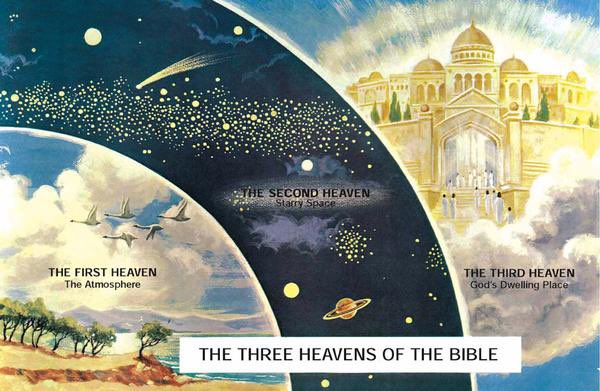
God originally created one heaven and He did not start dividing it until Genesis 1:6 –
And God said, Let there be a firmament in the midst of the waters, and let it divide the waters from the waters. And God made the firmament, and divided the waters which were under the firmament from the waters which were above the firmament: and it was so. And God called the firmament Heaven. And the evening and the morning were the second day.
Genesis 1:6-8
Why does this matter? What is the big deal? Well tucked away inside this sneaky case of deception, again, the very first verse of the Bible, is Satan’s attempt to blind the student of the Bible from recognizing that sin has occurred in two “realms” and that God has one plan for reconciling the earth and He has a separate plan for reconciling heaven. The Bible keeps each realm, heaven and earth, separate and distinct. God began His Word this way (Gen 1:1) and He ends it the same way (Rev 21:1). Each realm has its own program, people, and destiny. Earth has God’s prophetic program, Israel and the nations, and Heaven has the Church, the body of Christ.
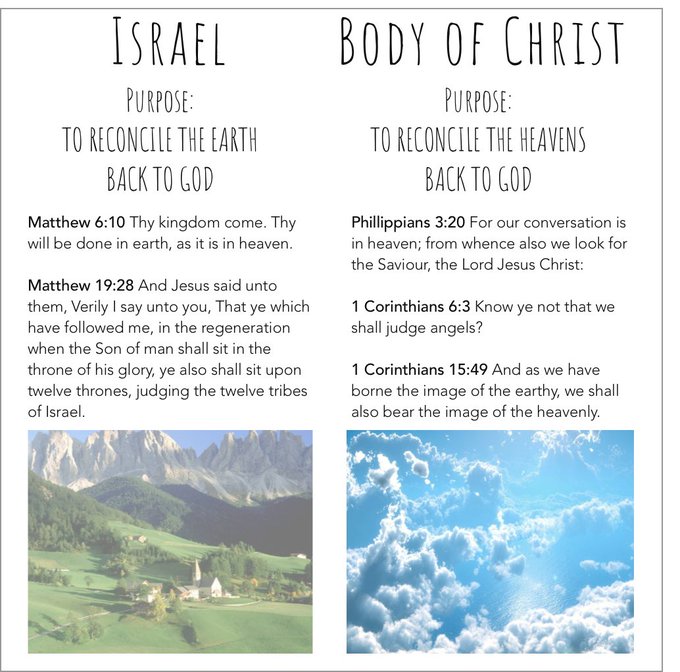
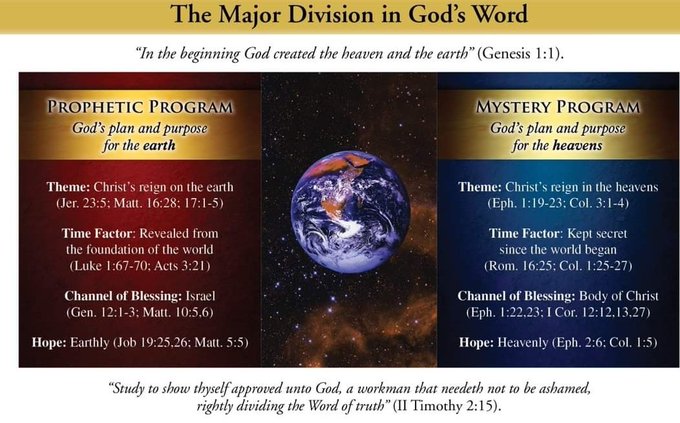
Genesis 1:1 provides us a very subtle form of deception, but make no mistake that Satan, our chief enemy, has been very effective with clouding the understanding of many a Bible student through his altering of Scripture. God chose Israel and the body of Christ to fulfill His twofold purpose concerning heaven and earth (Eph 1:10; Gen 1:1; Col 1:16, 20). The kingdom God promised Israel was prophesied from the foundation of the world (Mt 25:34) in response to Adam’s rebellion, and spoken about by the prophets since the world began (Acts 3:21). Israel will reign on the earth. The body of Christ was purposed before the foundation of the world (1 Cor 2:7; 2 Tim 1:9) in response to Lucifer’s rebellion, and kept secret since the world began (Rom 16:25; Eph 3:9). The body of Christ is predestinated to reign with Christ in His heavenly kingdom. One is blinded to this truth if they cannot trust the first verse of the Bible they study from…
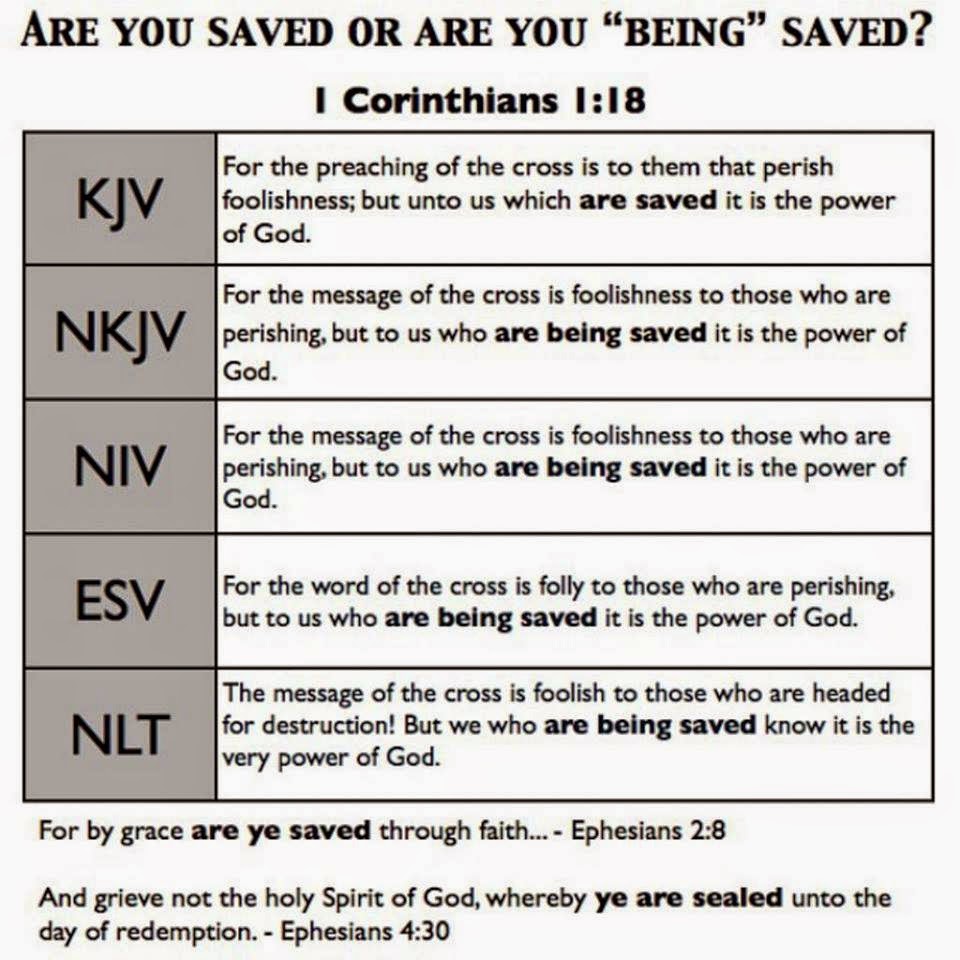
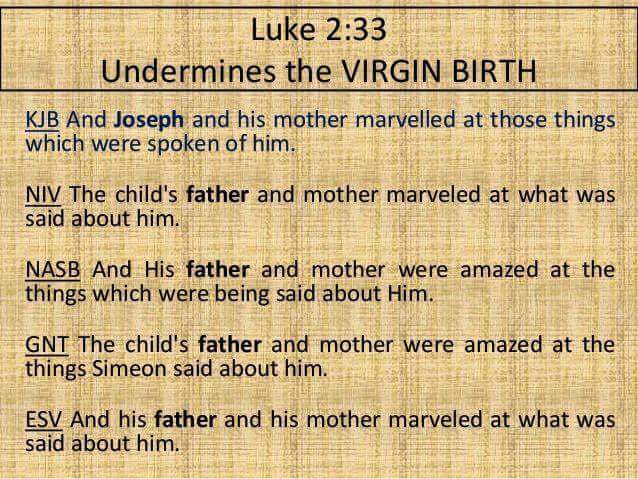
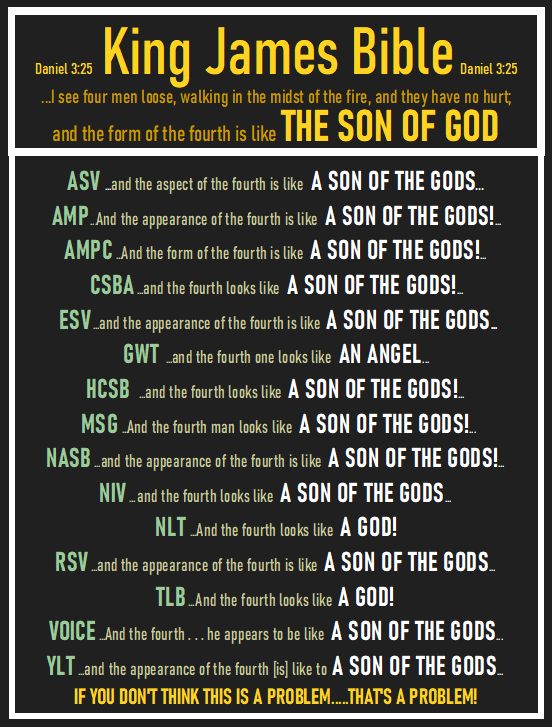
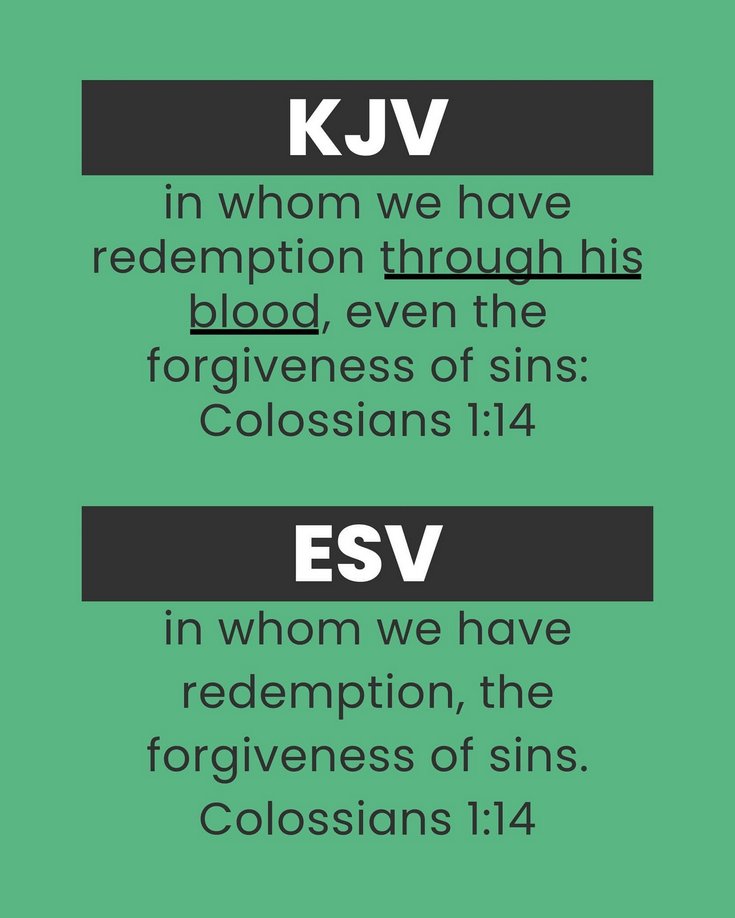
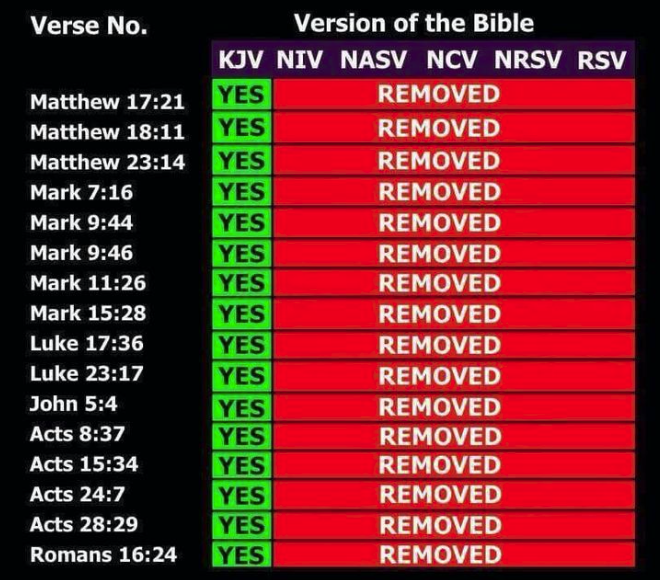
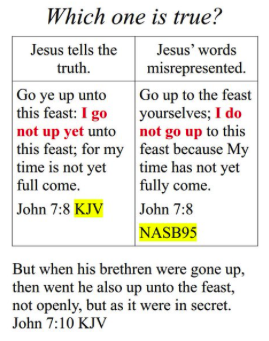
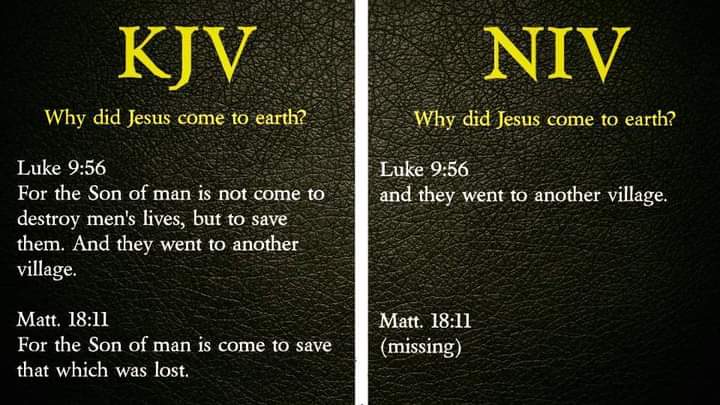
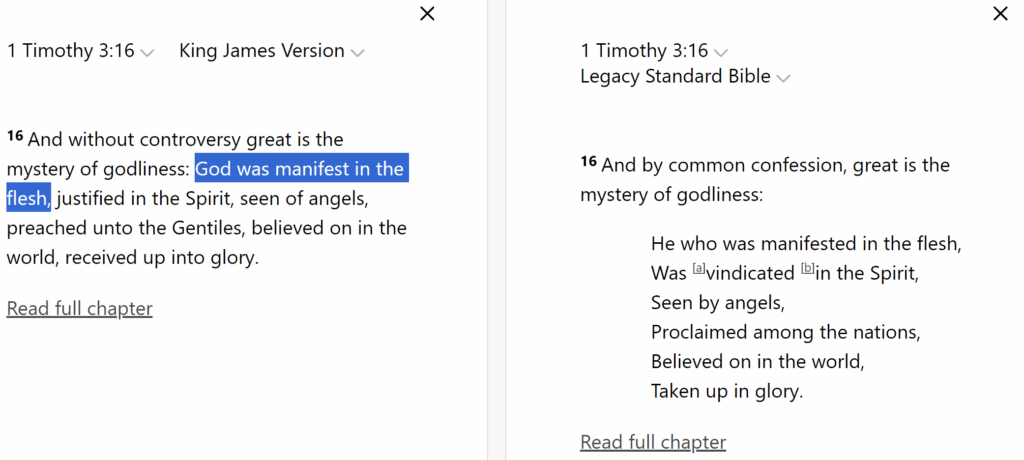
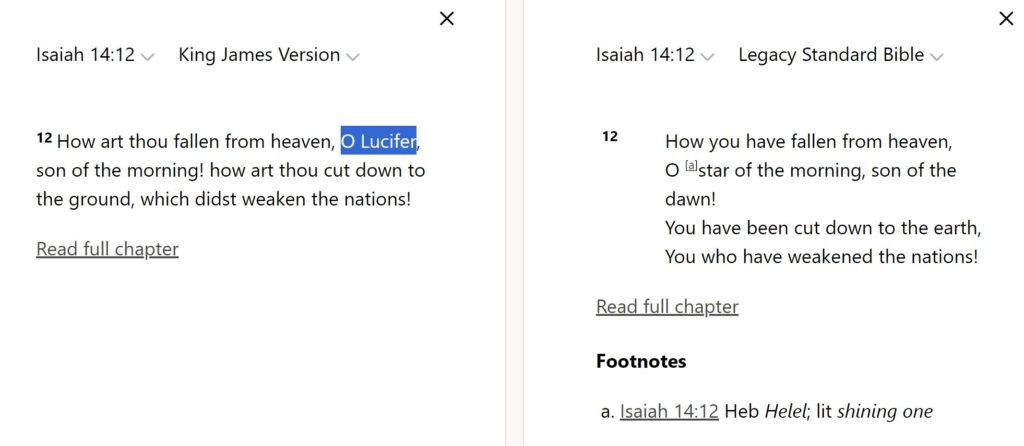
At this point, I could write page after page, demonstrating to you that the “modern day” versions of the Bible are corrupt and that the sincere student of the Bible should only use the KJB for their study, memorization, daily reading, and reference. While keeping in mind that “a picture is worth a thousand words,” I submit the following assortment for your consideration and future study instead:
Enduring Importance
The choice of which English Bible translation to use carries significant weight for anyone seeking to understand and apply Scripture accurately. The King James Bible is the superior and most reliable option available in English. The KJB is not merely one translation among many, but the standard that has stood the test of time, providing a stable foundation for doctrine, study, and spiritual growth. Deviating to modern alternatives risks confusion and error, as previously demonstrated.
One of the strongest arguments centers on the KJB’s unmatched historical stability and preservation. The King James Bible has remained essentially unchanged for over 400 years since its publication. This remarkable consistency sets it apart from other books and translations, ensuring that the preserved Word of God has not been subject to ongoing revisions or alterations that could obscure its original meaning. In an era where texts are frequently updated, this long-term fidelity offers believers confidence that they are reading the same Bible that guided generations of Christians before them.
The KJB also earns praise as the absolute best English translation the world has ever known. Its 400+ year history is a longevity that has allowed it to shape theology, preaching, and personal devotion across centuries without the fragmentation introduced by newer versions. Modern translations, by contrast, should be viewed with deep suspicion since they introduce changes that can alter doctrine and weaken the clarity of God’s message.
Using the KJB as one’s primary or “go-to” Bible for reading and study is essential for avoiding theological deception. This warning gains added force within the context of “right division” – the principle of distinguishing between God’s program for Israel and God’s program for the body of Christ. The KJB’s precise and consistent wording supports clear understanding of the distinctions that should be made while reading the Bible:
- Israel vs. the body of Christ
- Prophecy vs. Mystery
- Law vs. Grace
- Peter’s Ministry vs. Paul’s Ministry
- Kingdom doctrine vs. Church doctrine
- The Kingdom Gospel vs. the Gospel of the Grace of God
- An Earthly Kingdom vs. a Heavenly Citizenship
Modern versions, with their smoother but oftentimes altered language, can blur these vital areas of distinction and lead to confusion for the student of the Bible.
Ultimately, the advocacy for the King James Bible boils down to a commitment to God’s preserved Word in its most reliable English form. By maintaining the KJB as the standard, believers gain access to a translation that has proven itself through centuries of use, resists the pitfalls of modern revisions, and equips serious students for accurately handling the Scriptures. The King James Bible remains the trustworthy foundation for those who desire to rightly divide the word of truth (2 Tim 2:15 KJB) and their desire to grow in sound doctrine. Choosing it is not a matter of preference but a safeguard for spiritual clarity and fidelity to the text God has preserved.
A Matter of Trust
The choice of which English Bible to read, study, and trust can carry with it eternal consequences. Modern translations such as the ESV, NIV, LSB, and NASB (also called NASV) introduce changes that undermine the very words God has promised to preserve. These versions cannot be trusted because they deviate from the doctrine of preservation that underpins sound Christian faith and practice.
God has promised to preserve His words. This is not a vague idea but a specific commitment from the Lord Himself. Jesus declared that not one jot or one tittle would pass from the Law until all is fulfilled. This promise extends to the inspired words being kept complete and without error through the ages. When modern versions alter, remove, or replace words, they stand in opposition to this divine guarantee that believers can hold the exact words of God in their hands today.
The King James Bible stands as the English translation that faithfully represents this preserved text. There is remarkable stability within the King James Bible. The KJB has remained essentially unchanged for over 400 years, providing a consistent standard that modern revisions lack. This longevity is not accidental but reflects God’s faithfulness in preserving His words for His people.
Modern versions fail this test of preservation by making deliberate changes to the text. One of numerous examples is that the word “communion” has been entirely removed from the ESV, NIV, LSB, and NASB and replaced with weaker terms such as “sharing,” “participation,” or “partnership.” This is not a minor stylistic update but a substantive alteration that affects the precise language of unity and the Lord’s Supper. Such changes disrupt the oneness the church is meant to experience through the unchanging preserved words of God.
The problems extend beyond single words. Meaning is carried by exact words, not general ideas. Doubting or altering any word offends God because faith comes by hearing the word of God, and believers are to be thoroughly furnished through those precise words. Modern versions like the ESV, NIV, LSB, and NASB, by introducing variations, create a foundation of doubt rather than certainty. Christians who use those modern perversions risk building their theology on shifting sand instead of the rock of preserved Scripture.
Even seemingly small details reveal the superiority of the preserved text, the King James Bible. Belief in every word of the Bible you hold, as being inspired and preserved, is a solid foundation that every Christian must view as crucial. The comprehensive scope of the preserved text, with its precise counts of books, chapters, verses, and words demonstrate a complete and orderly presentation that modern versions fragment through omissions and substitutions.
Critics often attack the King James Bible for its language and a common complaint is described as “outdated vocabulary.” What the KJB contains, which modern perversions do not, is its own dictionary, definitions to words within its own pages. Capitalization and careful wording also matter. Distinctions are preserved within the King James Bible through its use of capitalization that other translations often flatten. The fact is that modern versions sometimes import or alter language in ways that dilute biblical precision.
Christians should reject corrupted modern versions because they do not uphold the doctrine of preservation. Using the ESV, NIV, LSB, or NASB introduces alterations to God’s Word that hinder unity and communion in the body of Christ. When God has preserved His words perfectly in the King James Bible, there is no spiritual benefit and actually significant spiritual risk in turning to versions that do not. The King James Bible alone offers the trustworthy, unchanging foundation Christians need. Modern versions, by contrast, represent a departure from that preservation and should discarded.
Modern versions such as the ESV, NIV, LSB, and NASB cannot be trusted. They alter preserved words, introduce confusion, undermine doctrinal precision, and prevent the unity that comes from one common Bible. Christians who desire to honor God’s promise to keep every word should reject these versions and hold fast to the King James Bible as the faithful English representation of His perfectly preserved Word. This is not preference but obedience to the truth that has been providentially maintained for our benefit and God’s glory.
Publishing Companies
The practices of publishing companies play a significant role within this version discussion. Publishing companies hold copyrights over modern English translations and have legal and commercial incentives that often lead to ongoing textual changes. This stands in stark contrast to the doctrine of preservation, where God is said to keep every word and even every jot and tittle stable for believers.
You need to know that modern Bible versions are not in the public domain. They are owned and controlled by publishing companies or foundations:
- The NIV is copyrighted by Biblica (with Zondervan/HarperCollins handling publication).
- The ESV is copyrighted by Crossway.
- The NASB (NASV) is copyrighted by the Lockman Foundation.
- The LSB (Legacy Standard Bible) is copyrighted by The Lockman Foundation.
These copyrights give the owners exclusive rights to reproduce, distribute, and create derivative works based on their specific translation. The King James Bible, by contrast, is in the public domain in the United States (though it remains under a form of Crown copyright/patent in the United Kingdom, managed primarily for quality control by publishers like Cambridge University Press rather than aggressive commercial restriction).
Copyright law (under U.S. statutes like 17 U.S.C.) protects the specific wording and creative expression of a translation. It does not protect ideas, facts, or the underlying biblical text itself. The purpose is to allow publishers to recoup costs, control quality, and prevent unauthorized copying or alteration by others.
Despite what many suggest, there is no strict legal requirement mandating that publishers change a specific fixed percentage of the text (such as 5%, 10%, or any other precise figure) simply to maintain an existing copyright or to keep selling their Bibles. When publishers create revised editions (which they frequently do), copyright law requires that the new version contain a sufficient amount of “original creative authorship” to qualify as a protectable derivative work or new compilation. Minor tweaks might not be enough for separate copyright protection on the revisions, while more substantial changes can allow the publisher to register and control a new copyrighted edition.
In practice, publishers revise translations periodically for reasons including:
- Updating, what they claim to be, archaic or unclear language for contemporary readers.
- Addressing perceived translation issues or feedback.
- Making theological or stylistic adjustments.
- Creating marketable “new editions” to drive sales.
These revisions often involve enough word changes, rephrasing, or updates to meet the threshold for new copyright protection. While no law dictates an exact percentage, the commercial reality is that meaningful changes are made to justify new editions and maintain control. This is distinct from the KJB’s long-term textual stability (over 400 years of consistency). This system has a clear negative impact on the kind of perfect, stable preservation that God intended:
- Textual Instability Instead of Preservation: Modern versions do not offer one fixed, unchanging text. Revisions create multiple editions with differing wording. This directly conflicts with the promise that God preserves His words without error so believers can trust their Bibles. Frequent changes mean the “Bible” evolves with publishing decisions rather than remaining constant across generations.
- Profit and Control Incentives Over Fidelity: Publishing companies are businesses. Copyright allows them to tightly control the text and profit from new editions, study Bibles, apps, and permissions. This can incentivize revisions for market appeal rather than strict adherence to an original preserved text. In the preservation controversy, this is viewed as a driver of the very word changes and potential doctrinal shifts criticized in modern versions (ESV, NIV, LSB, NASB), undermining God’s “one Bible” for unity and communion within the body of Christ.
- Encouragement of Ongoing Alterations: Because each sufficiently revised edition can be copyrighted anew, there is little legal or structural pressure toward long-term textual fixity. This contrasts sharply with the KJB’s history of careful stewardship (even under UK patent arrangements focused more on accuracy than frequent commercial overhaul). As a result, Christians using modern versions may encounter different wording depending on which edition or year they pick up. This erodes confidence in a perfectly preserved text.
- Broader Effect on the Controversy: In the Bible Version debate, copyright-driven revisions amplify concerns about “corrupted modern versions.” They make it easier for changes (whether minor or significant) to enter the text over time, supporting arguments that these translations prioritize readability, sales, or scholarly updates over the unchanging preservation of every word. This stands against the foundational teaching that God, not publishers, is responsible for keeping His words intact.
While copyright itself is a neutral legal tool that protects creative work and can prevent unauthorized tampering, the way publishing companies apply it to modern Bible versions (through periodic revisions that qualify for new protection) contributes to textual fluidity rather than stable preservation. The argument is simple … for those convinced of the need for one preserved English Bible (the King James Bible), this commercial and legal dynamic represents a significant obstacle to trusting versions that are subject to ongoing human-driven changes.
Christians seeking the unchanging Word are encouraged to prioritize the historically stable text over versions influenced by publishing cycles.
Verse Memorization
The King James Bible provides believers a final authority, not a moving target. If your standard (what you memorize, study from, carry with you, etc.) is the KJB, then realize that the text won’t change. What you have memorized will be the same 50 years from now. That can’t be said with modern day translations. A very simple example, using John 3:16, is as follows:
KJV: “For God so loved the world, that he gave his only begotten Son, that whosoever believeth in him should not perish, but have everlasting life.”
NASB95: “For God so loved the world, that He gave His only begotten Son, that whoever believes in Him shall not perish, but have eternal life.”
ESV: “For God so loved the world, that he gave his only Son, that whoever believes in him should not perish but have eternal life.”
LSB: “For God so loved the world, that He gave His only begotten Son, that whoever believes in Him shall not perish, but have eternal life.”
The KJB’s “archaic” forms (“whosoever believeth,” “everlasting life”) and consistent older phrasing stay fixed for those who memorize it. Shifting to NASB95, then ESV (which drops “begotten” in this example), then LSB requires adjusting the memorized wording each time for an exact match, even though the core meaning may be the same. This kind of variation across successive modern versions only results in more work for the student of the Bible. Pure and simple, commitment to the KJB avoids repeated relearning. There is an unchanging standard provided by God Himself and if you make it your life-long standard, it will not fail you.
Adorn the Doctrine
The larger issue with the modern day Bible versions is not isolated to just their wording, but the doctrine that is negatively influenced. Modern versions do not merely “update the language,” they alter, weaken, omit, and corrupt key truths that God preserved in His perfect word.
1) They attack the certainty of God’s preserved word:
The King James Bible says what it means with authority. Modern (per)versions constantly create doubt with footnotes, brackets, omissions, and conflicting readings. Instead of giving believers certainty, they leave people asking, “Did God really say?” That is the same tactic Satan used in the Garden of Eden.
2) They remove or weaken important verses and phrases:
Many modern versions either omit verses entirely or cast doubt on them. They also weaken words dealing with:
- the deity of Christ
- the blood atonement
- the virgin birth
- the lordship of Jesus Christ
- the absolute authority of scripture
- the words “dispensation” and “rightly dividing”
When verses are shortened, bracketed, or footnoted away, the result is confusion instead of conviction.
3) They come from corrupt manuscripts:
Modern versions are built largely on the line of manuscripts associated with Alexandria, Egypt, rather than the preserved traditional text underlying the King James Bible. Instead of trusting the received text God used and preserved through believers, modern scholarship often exalts manuscript critics over faith in preservation.
4) The King James Bible comes from the right textual line:
KJB believers hold that the Textus Receptus and Masoretic Text reflect God’s preserved words, and that the King James Bible is the faithful English translation of that preserved text. It is not just old English people are defending – it is the preserved word of God in English.
5) Modern versions often use weaker, watered-down language:
The KJB uses clear, doctrinally rich, spiritual language. Modern versions replace strong Bible terms with softer, casual wording. Words like:
- propitiation
- charity
- conversation
- justification
- reconciliation
…carry depth that modern versions often flatten or dilute.
6) Right division matters and Christendom often ignores it:
One of the greatest problems today is not just corrupt Bibles, but confused doctrine. Most churches mix together:
- Israel and the body of Christ
- Prophecy and Mystery
- Law and Grace
- Peter and Paul
- Kingdom doctrine and Church doctrine
The result can only be doctrinal chaos and that is Satan’s goal today.
The King James Bible stands as the word of God for today. God promised to preserve His words. The KJB has doctrinal strength, precision, and consistency. The KJB does not bow down to modern textual criticism and it has been used by God mightily to save souls, establish doctrine, and to edify saints. The KJB gives believers a final authority and not a moving target.
Modern “versions” are called “perversions” from this viewpoint because they do not merely differ in style, they corrupt doctrine, create doubt, and contribute to the doctrinal blindness already filling modern Christianity. The King James Bible is trusted as the preserved word of God in English. Right division is essential to understanding it. Paul’s epistles are the doctrinal pattern for the body of Christ today. When you believe the Book and rightly divide it, confusion gives way to clarity.